When President Droupadi Murmu conferred the Ashoka Chakra upon Group Captain Shubhanshu Shukla on 26th January 2026 at Kartavya Path, India witnessed more than a decorated officer receiving the nation’s highest peacetime gallantry award. Shux’s journey from CMS classrooms to commanding missions 400 kilometres above the Earth’s surface exemplifies what happens when education prioritises character alongside competence. For many, it was a moment of national pride. For those of us in education, it was also a moment of reflection—one that recognises courage manifests not only on battlefields but also in the pursuit of scientific excellence under extreme conditions for the betterment of the world.
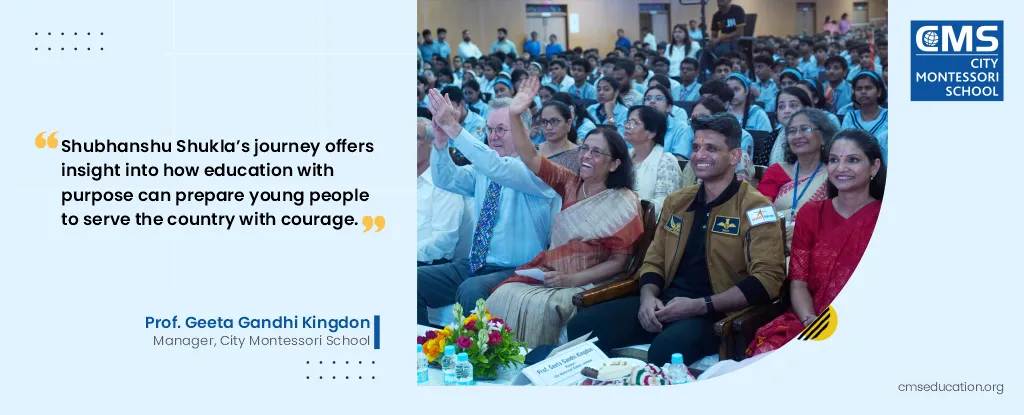
What kind of schooling helps shape an individual who places duty above self, remains steady under extreme pressure, and acts with moral clarity? The answer lies not in a single institution or teacher, but in a long, deliberate process of education that prioritises values, judgement and responsibility. As an alumnus of City Montessori School (CMS), Lucknow, Shubhanshu Shukla’s journey offers important insight into how education, when designed with purpose, can prepare young people to serve the country with courage.
Education is often assessed through short-term outcomes—examination scores, university placements, and career milestones. Yet the true impact of schooling is revealed much later, in moments when individuals are tested beyond comfort or recognition. Acts of gallantry, public service and ethical leadership are not spontaneous. They are shaped over years through consistent expectations, disciplined environments and exposure to complex moral questions.
At CMS, education has always been viewed as a long-term national investment. The school’s purpose extends beyond academic attainment to the formation of character and citizenship. This approach was pioneered by our revered Founder, the late Dr Jagdish Gandhi, and our Founder-Director, Dr Bharti Gandhi, who believed that education must prepare students to contribute to peace, justice and the common good—locally and globally, aligned to the age-old Indian philosophy of Vasudhaiva Kutumbakam.
Shubhanshu Shukla’s Ashoka Chakra is not an isolated outcome. It is evidence of what can emerge when education focuses on the whole individual, not just performance metrics.
The 6 Cs: A Framework for Transformative Education
At the heart of CMS’s educational philosophy are the 6 Cs: Character, Citizenship, Collaboration, Communication, Creativity and Critical Thinking. These are not taught as abstract concepts. They are embedded across curricula, co-curricular programmes and daily school life.
Character is developed through discipline, ethical discussion and accountability. Students are encouraged to reflect on choices, consequences and responsibility—long before they face real-world pressure.
Citizenship at CMS extends beyond civic knowledge. It is about understanding one’s role in society and recognising obligations to others. Students engage with issues of peace, justice and sustainability, fostering a sense of duty that transcends personal ambition.
Collaboration prepares students to work within diverse teams, respect differing perspectives and place collective outcomes above individual recognition—an essential quality in high-stakes environments such as defence services.
Communication is cultivated through debate, public speaking and dialogue, enabling students to articulate ideas clearly while listening with respect.
Creativity encourages flexible thinking and problem-solving, particularly in unfamiliar or constrained situations.
Critical Thinking equips students to assess information, question assumptions and make reasoned decisions—skills vital when operating under uncertainty.
In Lucknow, where CMS serves 64,400 students across campuses, this approach counters rote learning, emphasising skills for real-world impact. It develops global citizenship by exposing students to international conferences and exchanges, nurturing problem-solvers who think beyond borders and resulting in thousands of CMS alumni serving society, embodying these 6 Cs in their careers. These six competencies together create an educational environment where courage is informed by judgement and action is guided by values.
Shubhanshu Shukla: An Outcome of Values-Based Schooling
Group Captain Shubhanshu Shukla’s recognition with the Ashoka Chakra reflects qualities that are developed over time: composure, ethical clarity and commitment to service. Such qualities are not trained in isolation. They are shaped through years of structured learning, exposure to leadership roles, and an educational culture that encourages students to think beyond themselves.
As a CMS alumnus, Shubhanshu Shukla benefited from an environment that valued discipline alongside dialogue and excellence alongside empathy. Shubhanshu Shukla spent 15 formative years at CMS Aliganj Campus I, from early Montessori years through Class XII. This wasn’t merely time spent acquiring academic credentials. It was immersion in an educational ecosystem designed by our revered founders, late Dr Jagdish Gandhi and Dr Bharti Gandhi, to cultivate individuals who would serve the world, not merely succeed within it. At CMS, Shux wasn’t taught to dream of space—he was equipped to question, collaborate, lead, and act ethically in pursuit of those dreams.
Searches today for “Shubhanshu Shukla school” reflect a growing public interest in understanding how educational institutions contribute to leadership and service. The answer lies not in any single programme, but in a sustained commitment to values-based education.
A Consistent Pattern of Service Among CMS Alumni
Shubhanshu Shukla’s journey is part of a broader pattern among CMS alumni who have chosen paths of public service and societal contribution. Mr Prakash Gupta, IFS, the first and currently serving as Consul General of India in Seattle, represents India’s diplomatic engagement abroad. Mr Gopal Baglay, IFS, as High Commissioner of India to Australia, has played a key role in strengthening bilateral relations. Mr Manish Tripathi, through his work on the vastra for the idol of Ram Lalla at the Ayodhya Ram Mandir, has contributed to India’s cultural and spiritual heritage. Ms Menka Soni, the first Indian-American immigrant woman elected to the Redmond City Council, demonstrates civic leadership in a global democratic context.
These diverse paths—diplomacy, governance, culture and civic leadership—share a common DNA—education that instilled in them the conviction that success means service, that accomplishment obligates contribution and that privilege demands responsibility. Thousands of other CMS alumni lead in medicine, entrepreneurship, and policy, all driven by the spirit of Jai Jagat.
Conclusion: A Vision for Education’s Future
Schools rarely witness the full impact of their work. The outcomes of education often emerge decades later, in boardrooms, courtrooms, diplomatic missions or, as in this case, in acts of extraordinary courage. The Ashoka Chakra awarded to Shubhanshu Shukla is not an end point. It is a reminder of what purposeful, transformative global citizenship education can enable.
The challenges confronting humanity—climate disruption, geopolitical instability, technological transformation, skilled resource scarcity, etc—will require leaders who possess not merely technical expertise but also moral courage, collaborative capacity, and genuine commitment to collective welfare. At City Montessori School, our commitment remains unchanged. We will continue to invest in education that develops character before acclaim, responsibility before recognition, and service before self. In doing so, we hope to prepare future generations—not for honours, but for the demanding task of serving the nation and the world with courage, judgement and conscience.