
Reflection from the CMS Managing Director
Cricket as a Classroom for Global Citizenship Education
Welcome to the 7th International School Cricket League 2025, organised by CMS Kanpur Road Campus.
In schools, the cricket field often teaches lessons that are harder to learn in a conventional classroom. At City Montessori School, we see sport not as an accessory to academics but as an important part of holistic education. As CMS hosts the 7th International School Cricket League (ISCL) from 13th to 19th December 2025 at the CMS Kanpur Road campus, the event reflects our belief that structured school sports can strengthen unity, discipline, teamwork, global citizenship, and excellence. For students, cricket becomes a practical environment to learn how to think clearly, act responsibly, work together, and compete with integrity.
The ISCL is more than a school cricket event in Lucknow; it is a strategic educational programme shaped around the demands of the modern world.
Aligning Sport with Global Frameworks: UN SDGs 4, 10, and 16
Our vision for ISCL is intrinsically linked to the United Nations’ Sustainable Development Goals. Specifically, the event is a practical vehicle for advancing:
- SDG 4: Quality Education. We redefine quality education by extending it beyond academics. The league’s intense environment—from strategising with international peers to adapting to different playing conditions—cultivates critical thinking and real-time problem-solving. This experiential learning complements formal education, creating a holistic development model that is central to CMS’s philosophy.
- SDG 10: Reduced Inequalities. The cricket pitch is a great leveller. By bringing together teams from diverse socio-economic and national backgrounds onto a single platform in Lucknow each December, we consciously reduce barriers. Talent and sportsmanship, not origin, become the primary metrics of success. This inclusive access to a high-calibre international event empowers participants and challenges prejudices.
SDG 16: Peace, Justice & Strong Institutions. The rigorously enforced rules and fair-play protocols of ISCL mirror strong, just institutions. Umpires’ decisions are respected, disputes are managed within a framework, and the spirit of the game is paramount. This microcosm teaches young participants to uphold principles, resolve conflicts peacefully, and trust in equitable systems—foundational skills for peaceful societies.
The “Six C’s” in Action on the Cricket Field
At CMS, we champion the “Six C’s” of education: Character, Citizenship, Collaboration, Communication, Creativity, and Critical Thinking. The ISCL serves as a powerful incubator for each:
- Character & Citizenship: Facing victory with humility and defeat with grace builds integrity. Living and competing with a global peer group in Lucknow expands a student’s identity from local to global citizen.
- Collaboration & Communication: Cricket is the ultimate team sport. Success demands seamless collaboration and clear, often non-verbal, communication under pressure, skills directly transferable to future professional and personal endeavours.
- Creativity & Critical Thinking: Every over bowled and every batting partnership requires innovative strategy and rapid analysis. Captains and players must constantly assess opponents, adapt tactics, and solve complex game-time problems—a masterclass in applied creativity and critical thought.
Forging Global Citizens Through Strategic Competition
For CMS, the ISCL is a strategic investment in student development. Modern education requires schools to prepare children not only for examinations but also for a fast-changing world. Cricket strengthens critical thinking because students must read the pitch, anticipate risks, and solve problems instantly. It strengthens communication because players must share information under time pressure. It strengthens leadership, as young captains learn to motivate teams and manage situations.
The participation of teams from over 16 countries transforms Lucknow into a global village every December. When a young cricketer from Lucknow bowls to a batter from South Africa, or when students from Australia and Nepal discuss strategy, they are engaging in a practical dialogue of cultures. They learn to negotiate differences, find common ground, and build mutual respect—the very bedrock of global citizenship.
These skills translate into academic confidence and improved well-being. For participating schools, structured tournaments help build engagement, attendance, and school pride. For families, they offer evidence that a school’s commitment to holistic development is serious and sustained. The challenges of navigating travel, adhering to a strict tournament schedule, and interacting with officials from the Uttar Pradesh Cricket Association instil discipline, responsibility, and an understanding of institutional frameworks. The school cricket event becomes a simulation for navigating a globalised world.
The ISCL represents CMS’s long-term belief that education must be broad, balanced, and future-facing.
Why CMS Sees Sport as a Strategic Educational Priority
As CMS prepares to host the 7th ISCL school cricket event in Lucknow, the aim is not only to celebrate cricket but also to reaffirm our educational philosophy. We are demonstrating that sports, particularly a discipline-rich game like cricket, can be a powerful pedagogical tool. It prepares young minds not just for future sporting accolades but for the challenges and opportunities of an interconnected world. Sport shapes disciplined, reflective, and responsible young people. It gives children the space to develop integrity, fairness, and collaboration—values needed for a peaceful and inclusive world.
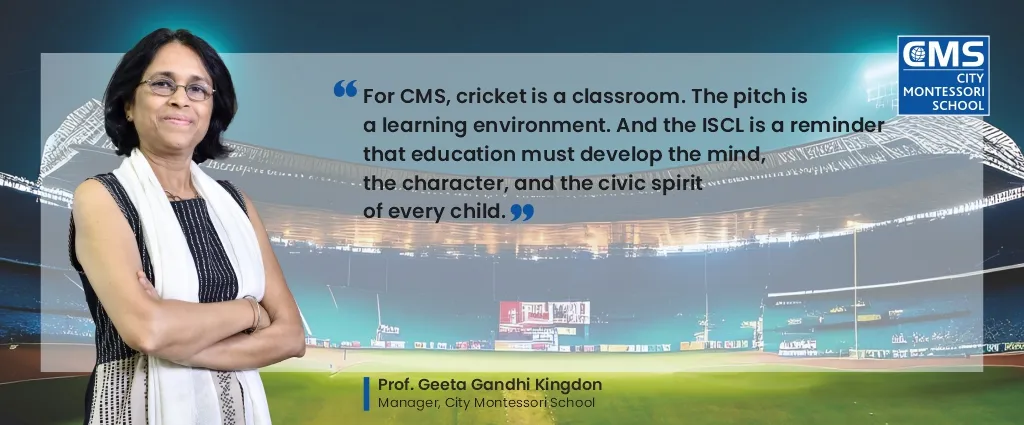
For CMS, cricket is a classroom. The pitch is a learning environment. And the ISCL is a reminder that education must develop the mind, the character, and the civic spirit of every child. Come to Lucknow not only to win a coveted trophy but also to participate in a unique educational experience—where every match is a lesson, every opponent a teacher, and the entire league a comprehensive classroom for global citizenship.