
CMS COFAS 2026 Redefines Technology with a Purpose in Education
Modern education stands at a critical juncture. For too long, we have treated digital literacy as an end in itself—a matter of mastering devices, navigating platforms, and consuming content. The defining challenge of our time is not whether students can use technology, but whether they can direct it toward meaningful human ends. At City Montessori School, we strive to ensure that education must develop analytical, critical thinking and problem-solving abilities, as well as instil the vision that allows a school student to become a self-motivated agent of social change. This conviction animates COFAS 2026 – 23rd International Computer Olympiad.
The global landscape presents a paradox. Artificial intelligence and digital tools have become remarkably powerful, yet their benefits remain unevenly distributed. According to the World Bank, 2.2 billion people worldwide still lack internet access, including 1.4 billion women, primarily because they cannot afford data or devices1. Meanwhile, a recent survey of students across sixteen countries found that 86% now use generative AI, yet only 23% feel prepared to do so responsibly. This gap between access and ethical preparedness defines the challenge COFAS 2026 addresses2.
The theme “Digital Humanity – Technology with a Purpose” is our response to this moment. As our revered CMS founder, late Dr Jagdish Gandhi observed, “Science and technology that are directed toward the good of humanity are indeed praiseworthy achievements.” Technology devoid of moral direction is a wasted asset. COFAS 2026 asks young innovators to consider how digital tools can bridge divides rather than deepen them.
This 4-day international event provides an international platform for young minds to tackle real-world challenges through sustainable engineering and creative problem-solving. The event brings together thirteen international student teams—including participants from Thailand, Uganda, Bangladesh, and Nepal—alongside eleven national teams and thirty-two local teams. Through game designing, robotics, digital creativity, debate, poster-making, dramatics, music, and dance, participants demonstrate that technology and human creativity must complement each other. The Olympiad connects directly to the UN Sustainable Development Goals, particularly SDG 4 on Quality Education and SDG 9 on Industry, Innovation, and Infrastructure.
The twenty-third edition of COFAS, organised by CMS Rajendra Nagar Campus I from 13 to 16 October 2026 at the World Unity Convention Centre (WUCC) Auditorium at CMS Kanpur Road Campus in Lucknow, represents more than a competition. It embodies our conviction that digital literacy is no longer optional—it is an essential life skill that must include the critical ability to understand, question, and use technology safely, ethically, and responsibly. As our founder, late Dr Jagdish Gandhi, often reminded us, education is the greatest service that can be rendered to humanity, building character and inculcating the vision that will “rehabilitate the fortunes of humankind.”
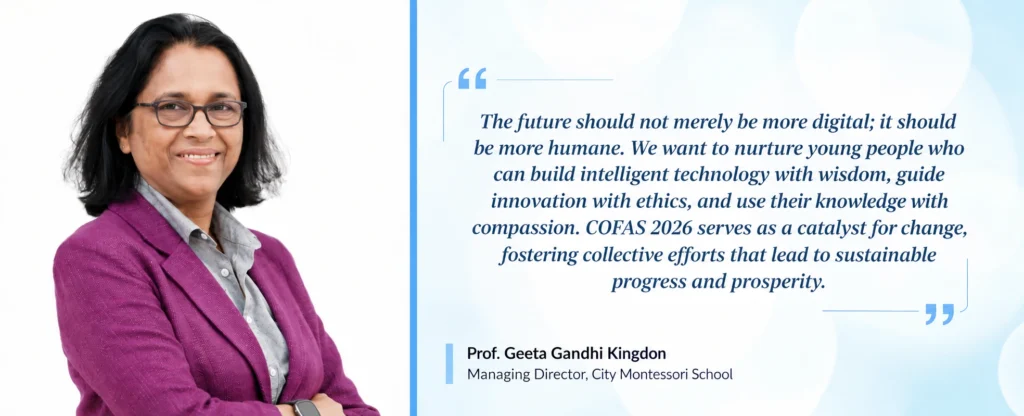
Our message is simple: the future should not merely be more digital; it should be more humane. We want to nurture young people who can build intelligent technology with wisdom, guide innovation with ethics, and use their knowledge with compassion. At CMS, this vision finds expression in our motto, “Jai Jagat”—victory to the world—and that true education releases capacities not for personal gain alone, but for service to the world in the spirit of Vasudhaiva Kutumbakam (all earth is one family).
COFAS 2026 will thus serve as a catalyst for change, fostering collective efforts that lead to sustainable progress and prosperity. It empowers the next generation in Lucknow and beyond to harness digital tools as instruments of universal peace and societal transformation. The true measure of technology is not how much it transforms machines, but how much it transforms lives.
1 https://www.worldbank.org/ext/en/digital-ai
2 https://www.jitcai.org/index.php/journal/article/download/The-Impact-of-Generative-AI-on-Student/4